Wednesday, May 18, 2016
Shunned - Without a Map
It is interesting how the stigma of a teen pregnancy has changed. Meredith tries her best to hide her pregnancy from her friends, family, and community as a whole, in fear of being judged and shunned (which is what happened). For instance, she gets expelled from school, coming home with a green note saying so. At school before getting expelled, she does not shower after gym for a month, in fear that her friends would notice that she was pregnant. Their reaction when she finally told them, was simply them being silent anad walking away from her. Her parents came to the decision that the baby would immediately be given up for adoption. People around town would become silent and would whisper when they would see Meredith walk by. One person even had the audacity to ask if Meredith got "knocked up". Although people today still have a certain degree of judgement when it comes to teen pregnancy, it is much more accepted and respected. People are more apt to help and be more supportive of the stressful situation. For instance, it is encouraged that teen mothers finish high school instead of dropping out. Friends and family nowadays are more apt to listen to what the mother wants for herself, instead of making decisions for her. Also, they are usually more understanding, wanting to help instead of shying away.

Thursday, March 3, 2016
Henry the Caterpillar/ Molokai Response
In my book, Henry the Caterpillar, what essentially happens is that Henry is living life happily doing what he likes to do, which is eat plants and play. One day, he goes to see what his brother and his brother’s friends are up to. But when Henry gets to them, they are hanging upside down on a leaf, which seems weird to Henry. Henry then asks if they want to come down to play with him, to which his brother responds, “Henry, we can’t come down right now. You wouldn’t understand. You aren’t ready yet”. Henry then becomes sad for feeling excluded from a group that he had always been around. He then leaves, feeling lonely and little confused, but soon stumbles upon a new group of caterpillar friends to be around. They, like him, like to eat and play. But then one day, as they have all put on some weight after eating so much, they all get very tired and decide that hanging upside down on a leaf would be very relaxing and would be a nice way to rest. They all fall into a deep sleep, soon turning into butterflies. They hatch from their cocoons, dry off their wings, and start flying together. They soon find Henry’s brother and his brother’s friends, who have also transformed into butterflies! They all fly together, and Henry knows he has grown up and no longer feels excluded.
Like Rachel in Molokai, Henry is excluded from a
society, but soon finds a new community where he is accepted due to having
others being similar to him in this new group of friends. Rachel in Molokai gets shunned from her
hometown after people find out that she has leprosy. Being a young girl, she does not fully
understand the whole situation or why people are so unaccepting of her due to
simply having this disease. This is
similar to Henry being confused when his brother and his brother’s friends were
excluding him when they said they did not want to come down to play with
him.
Rachel soon goes to Molokai, an accepting environment
where there are sick people like her, and where people receive no judgement for
having leprosy. This is just like how
Henry found a new group of caterpillar friends to be around who were similar to
him. Unlike the last group of
caterpillars, this new group likes to eat and play just like him, creating an
overall more comfortable and positive environment for Henry to be a part of.
Growing up in Molokai, Rachel realizes the struggles
of having her illness and knows that it will take time until she gets accepted
into the community she used to be a part of, before coming to Molokai. Although Henry
the Caterpillar has a happy ending, Henry finally becoming a butterfly is
similar to Rachel realizing answers to her past that she was confused about
before.

Wednesday, January 13, 2016
Moloka'i: Haleola
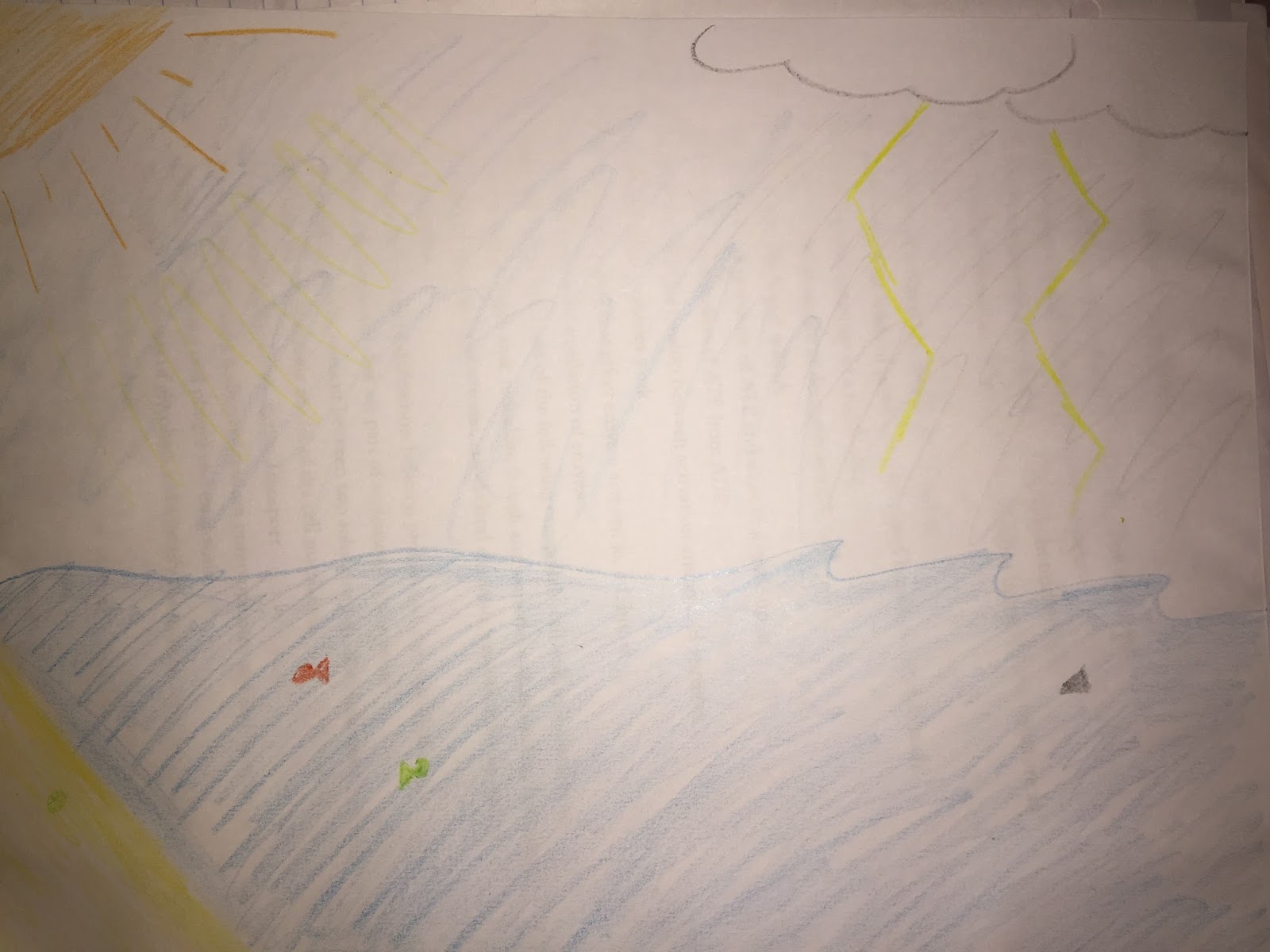
"I believe in the island. I believe in the land."
For my character, Haleola, I decided to draw a scene versus an object. In this scene that I believe is a symbol for Haleola, on one side of the drawing, there is a storm with lightning, choppy water, and a shark. Obviously, that side is the "bad" side. On the "good" side however, there is an illuminating sun radiating heat, calm water with fish, and a safe shore. The "bad" side represents people coming from a tough situation, such as Rachel. Rachel was put to shame by people in her community due to her leprosy, soon having to go to the island of lepurs. Rachel was nervous about coming to the island, being isolated from those who weren't sick with this shameful disease. However, when she sees the island of lepurs, she feels more welcomed than anything, as many of those on the island were at the shore to welcome the ship with the new arrivals. The first person to welcome her is Haleola, setting the tone for Rachel's treatment there and being Rachel's adopted aunt. The "good" side of the picture represents the comfort and welcoming that Haleola provides others with, making her like the sun and the shore, providing safety and love to those who feel insecure and lonely, especially going to a place of isolation. She has a love for the lepur colony and for Hawaii's past. She is also a believer in the old Hawaiian religion. The quote best represents Haleola, as she is proud to be Hawaiian and to be affiliated with what it is, but is also content with being at the island for the lepurs. She has a positive attitude about her life and the circumstances in it, despite how difficult it can be at times. She is like the radiating sun, giving people what they need, while also acting as the shore, being there for support and being that first welcoming person of many in the community.
Wednesday, December 23, 2015
Joy Luck Club Onion Peel
In The Joy Luck Club, something prevalent throughout
the movie is sacrifice. Especially the
mothers. The mothers constantly
sacrifice their own lives and desires in order to better the lives of their
children, or to set an example for them to follow. For example, An-mei’s mother sacrifices pain
and flesh from her arm to honor her own mother, Popo. It is as though the pain
is nothing compared to her obligation to her mother. An-mei Hsu's mother also
sacrifices her body to Wu Tsing so that she can have at least some status
instead of becoming a beggar. She does this so that An-mei can look up to her.
Her suicide, while seemingly selfish, is the ultimate sacrifice she can make
for An-mei. By killing herself, she is showing An-mei that being a second-rate
concubine, used and disgraced, is no way to live. In dying, she gives An-mei
the strength to carve her own path in life, and to not follow one like
hers. In China, Ying-Ying St. Clair was married
to Lin-Xiao with a baby boy until Lin-Xiao abuses her and abandons her for an
opera singer. Overcome by her depression, Ying-Ying accidentally drowns her
baby son in the bathtub, she lost "the thing that mattered the most." Many years later when Ying-Ying goes to
America and remarries, she see that her daughter Lena is unhappy with her
marriage, Ying-Ying reasserts herself by knocking over a table in the bedroom
and causing the vase to fall from the table and break. Lena goes to her mother
and admits her unhappiness. Ying-Ying replies that Lena should leave and not
come back until Harold gives her what she wants. She says this as she herself was in a bad
marriage, causing lots of trauma and sadness for her. She does not want Lena to go through the same
thing (of not having love for her husband and constantly doing things the way
he wants). The mothers in the movie not
only make a great sacrifice in leaving China in hopes of finding a better life
for their daughters, but also make great sacrifice in trying to make them
better people and have them lead better lives.

Monday, December 7, 2015
Regret Poem
Feeling sorry for an action
Or saying something
You do not wish
Oh I know oh oh that I let you down,
Is it too late to say sorry now?
Coming to terms with the past
will help you get along
Or saying something
You do not wish
Oh I know oh oh that I let you down,
Is it too late to say sorry now?
Coming to terms with the past
will help you get along
 |
| Justin Bieber wants you to forgive him...he regrets what he has done to you. "Is it too late to say sorry now?" |
Sunday, December 6, 2015
Jenny: An Antagonist to Readers

Monday, November 2, 2015
Figurative Claustrophobia
 |
| A picture of the beautiful state of Colorado. However, for Polly, this place is what she would like to escape from. |
 |
| Just this picture makes me anxious. |
I felt a similar way when in my math class last
year. Honors Pre-Calculus is definitely
the hardest class I have ever taken in high school, and simply getting a B- was
a huge struggle for me. The subject was
difficult, the amount of homework a night was extensive, and the way the
teacher explained how he went about problems was difficult for me to
understand. And with “Work to Rule” in
place, my teacher stayed after school very infrequently, therefore making
getting extra help difficult. As a
result of all of this, I would get very stressed out about the tests, and I would
even feel stressed when just entering the classroom. Whenever I walked in, just like Polly, I felt
as if the walls were caving in on me.
That class stressed me out, everything about it. And walking into the classroom also became
something very uncomfortable to me. My
liberation was difficult, as I literally had to wait until June to leave that
class: the end of the year. Over the
course of the year, I struggled getting a B-.
Although it was difficult, I knew that I just had to get through that
second period class every day, and get by until the end of the year. After my last test, the moment of liberation
was when my math teacher told me that I had received a 79.5 for the semester,
which he was rounding up to an 80. It
was one of the happiest moments in my academic career. I was relieved that everything about that
class was behind me, and that one last push was what got me to where I wanted
to be. The stress was now gone. The place that made me feel mentally
uncomfortable and frustrated was now a thing of the past.
Now, I am much happier and less stressed from no
longer being in that class. Although I
have difficult classes this year as a senior, even taking Honors Calculus, none
of them compared to the stress I felt from just being in my Honors Pre-Calculus
class. I am now liberated, and now am a
less anxious and a lot more happy.
Monday, October 26, 2015
Creating Mood and Atmosphere
In the novel Jane Eyre by Charlotte Bronte, weather is
Bronte’s tool to set the tone and mood for foreshadowing positive or negative
events. This technique is exercised
throughout the entire novel, alerting the readers of what is to come through
the use of atmosphere description. In
the following scene, I, like Charlotte Bronte, set the scene of a story through
the use of atmosphere to create the mood.
I was walking. Now I'm running. The air is as cold as clear ice, however the situation I am in is anything but clear. I am so lost, running through the mud in the dark woods. The day is rainy and stormy, and I have yet to see another living thing. Although they cannot be seen, the noises of hooing of owls and the howling of coyotes are what fill the air. Scared, I simply keep running until I can find my way out.

The way I even got into this mess, was by wanting to take some pictures of the trees. The day started out so beautifully, with a nice blue sky and soft wind to rustle the trees. I was there in the woods alone, to take pictures of the different colored leaves that were all different shades of red, orange, or yellow. Besides the sound of birds chirping and the sound of the rustling of the trees every now and then, there was complete silence. It was not an eerie silence, but rather a peaceful silence. I was not until the birds stopped chirping, the wind started to blow the trees harder, and the sky went from blue to grey in an instant that, that I knew my photo shoot was over and that I needed to head home. The new mission: to get home, which was in walking distance from where I was. The problem: It was the first time I had ever entered these woods on my own, so I was not very familiar with it. It was then that I realized I was lost.

I was walking. Now I'm running. The air is as cold as clear ice, however the situation I am in is anything but clear. I am so lost, running through the mud in the dark woods. The day is rainy and stormy, and I have yet to see another living thing. Although they cannot be seen, the noises of hooing of owls and the howling of coyotes are what fill the air. Scared, I simply keep running until I can find my way out.
The way I even got into this mess, was by wanting to take some pictures of the trees. The day started out so beautifully, with a nice blue sky and soft wind to rustle the trees. I was there in the woods alone, to take pictures of the different colored leaves that were all different shades of red, orange, or yellow. Besides the sound of birds chirping and the sound of the rustling of the trees every now and then, there was complete silence. It was not an eerie silence, but rather a peaceful silence. I was not until the birds stopped chirping, the wind started to blow the trees harder, and the sky went from blue to grey in an instant that, that I knew my photo shoot was over and that I needed to head home. The new mission: to get home, which was in walking distance from where I was. The problem: It was the first time I had ever entered these woods on my own, so I was not very familiar with it. It was then that I realized I was lost.
So now, I am trying to get home, by myself, in some
unfamiliar woods, in the worst weather conditions. My phone is dead, so the best thing to do is to
try to retrace my steps. I am running,
as I am scared, cold, and anxious to get home as soon as I can. Hopefully someone will find me out here.
Monday, October 19, 2015
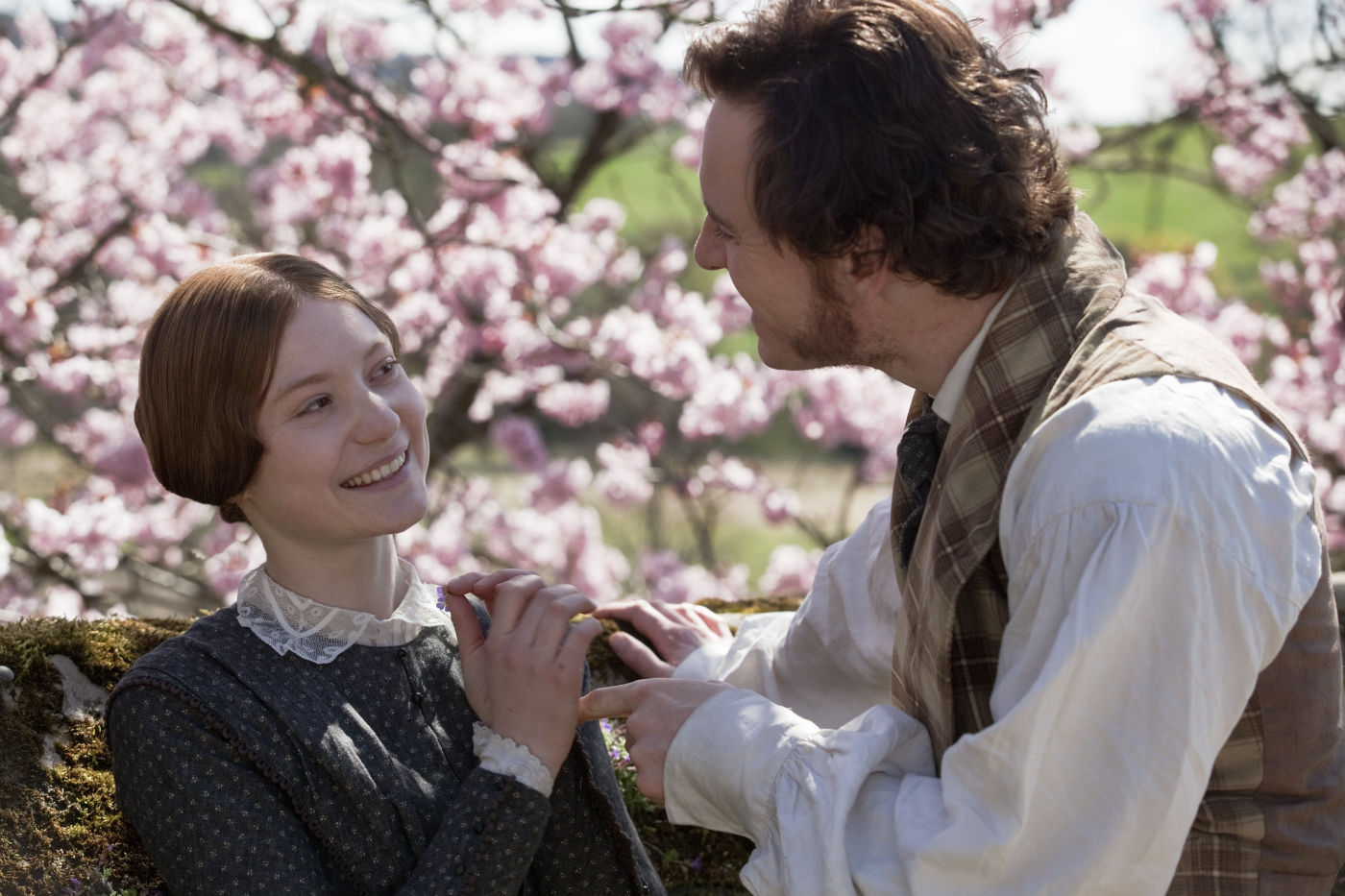
Jane Eyre Picture and Quote
My picture that represents Jane Eyre, is a picture of gray stairs going up from left to right. On the left, there are gray clouds and rain, but as the stairs go up and continue on the right side of the page, the weather gets better. There is now a blue sky with a great, shining sun instead of a dull sky with dreadful weather. This represents Jane, as it shows her growth and what she has been through in life. When she was young, she dealt with much disrespect and not enough love. She was an orphan who had to take care of herself early on in life, since there was no one else who cared enough to do so at Gateshead. However, once she is at Lowood, she begins to develop even more as a person, building strength within herself and having a new understanding of others' ideas and perspectives. She even becomes a teacher at Lowood for a few years, soon wanting a change in pace. She then becomes a governess at Thornfield, where she develops romantics feelings towards Rochester. When she runs away to Marsh End, she is able to meet family she never knew she had, inherits money from a relative, and realizes the unconditional love she has for Rochester. She then goes on to marry him, and even have a child with him, living life very happily. The stairs in the picture show how Jane's life and character slowly grew and improved.
 In Chapter 12, Jane states “It is in vain to say human beings ought to be satisfied with tranquility: they must have action; and they will make it if they cannot find it.” Jane took action to make her life the way she wanted it to be. She took advantage of her education, her jobs as a teacher and governess, and the love she deserved, in order to live successfully and happy.

Tuesday, October 13, 2015
Jane Eyre Onion Peel
I feel like I can connect this to my own life, since many will judge me when they first meet me as well. Little did Hannah know, Jane was actually in a higher class than she thought, even though she did not appear to be. Little do many know, I am actually Hispanic, despite the fact that I look completely Caucasian. When people first meet me, they see that I appear to be very pale with freckles, speaking English without an accent. They immediately assume that I am a complete white girl. When people get to know me, they soon learn that yes, I am white, but I also am very Hispanic.

I say very
Hispanic, since I am very in touch with that side of me; I am a spitting image of my Hispanic mother,
I speak fluent Spanish, and I overall relate to those who are Caucasian and Hispanic. People always judge based on appearance, especially
when meeting someone for the first time.
I very much can relate to Jane, who also felt unrightfully judged at a
certain moment in time; when Hannah rejected her for appearing poor.

The first picture is of a stereotypical Hispanic woman. The second picture is of my brother and me, two people who many do not assume to be Hispanic, based on our pale complections and based on certain characteristics we have.
The first picture is of a stereotypical Hispanic woman. The second picture is of my brother and me, two people who many do not assume to be Hispanic, based on our pale complections and based on certain characteristics we have.
Monday, October 5, 2015
Jane Eyre Reading Response
Although Jane is an artistic and passionate girl from the beginning, but was treated unfairly and without love for much of her childhood. Jane begins to find herself through role models, and matures through the years as she goes from Gateshead, to Lowood, and to Thornfield.

 Now much older than the childish ten-year-old she was, Jane realizes that when she does not let the opinions of others, like Mr. Brocklehurst or Ms. Reed, affect her, there is no oppression to dread. she realizes that she is bound only by her determination and free will regardless of the authority that she has traditionally been bound to please. She discovers her own strengths through her experiences in the world and therefore becomes a mature person. Now as a mature adult taking responsibility for her own actions, Jane wants to reconcile with her aunt, who is on her deathbed. Although Jane went through a tough childhood being raised by her aunt, she still wants to make up and end on good terms, wanting to thank her for caring her for her the best she could. “I approached my cheek to her lips: she would not touch it. She said I oppressed her by leaning over the bed, and again demanded water. As I laid her down--for I raised her and supported her on my arm while she drank--I covered her ice-cold and clammy hand with mine: the feeble fingers shrank from my touch--the glazing eyes shunned my gaze,” Although her aunt has no interest in essentially making up with Jane, Jane is mature in how she dealt with the situation and with even making the effort to see this aunt who never loved her.
In the beginning in Gateshead, Jane is familiar with the feeling of lonliness. "To that feeling of isolation I was accustomed; it did not oppress me much," (28). This shows just how mature Jane has become. By being denied her childhood, she has grown to maturity early. Jane has grasped what it means to be an adult, alone in the world. She even goes on to explain what she does on her own. “I had risen half an hour before her entrance and had washed my face, and put on my clothes by the light of halfmoon setting, whose ray streamed through the narrow window near my crib,” (50) As a ten year old, Jane is already responsible for herself and getting ready by herself. She doesn’t rely on anyone to help her, even when it is simply means getting ready.
Before even arriving to Lowood, Jane's aunt Ms. Reed tells Mr. brocklehurst, the supervisor of the boadring school, that Jane is a liar. As a result, Jane fights back and tells Mr. Brocklehurst that what her aunt said about her being a liar wasn’t true. She showed maturity, since it is a lot of times rare for someone so young to speak up for him/herself, as it can be a scary and intimidating this. At Lowood, Jane begins to have more of an open mind and is begginning to be positively influenced by role models, such as Helen. Helen says to Jane, “I make no effort; I follow as inclination guides me. There is no merit in such goodness...You will change your mind, I hope, when you grow older: as yet you are but a little untaught girl,” (68). Helen explains and tries to get young Jane to understand that sometimes one must have an open mind to get along with others. For the next six years, Jane excels in her studies, and after spending two more years at Lowood as a teacher, Jane decides she is ready for a change. Being a diligent student, a dedicated teacher, and soon wanting change, is a true sign of maturity. Jane is no longer a child, but rather an adult who seeks to experience and get the most out of what she can during her time at the Lowood Boarding School for orphan girls.
Now much older than the childish ten-year-old she was, Jane realizes that when she does not let the opinions of others, like Mr. Brocklehurst or Ms. Reed, affect her, there is no oppression to dread. she realizes that she is bound only by her determination and free will regardless of the authority that she has traditionally been bound to please. She discovers her own strengths through her experiences in the world and therefore becomes a mature person. Now as a mature adult taking responsibility for her own actions, Jane wants to reconcile with her aunt, who is on her deathbed. Although Jane went through a tough childhood being raised by her aunt, she still wants to make up and end on good terms, wanting to thank her for caring her for her the best she could. “I approached my cheek to her lips: she would not touch it. She said I oppressed her by leaning over the bed, and again demanded water. As I laid her down--for I raised her and supported her on my arm while she drank--I covered her ice-cold and clammy hand with mine: the feeble fingers shrank from my touch--the glazing eyes shunned my gaze,” Although her aunt has no interest in essentially making up with Jane, Jane is mature in how she dealt with the situation and with even making the effort to see this aunt who never loved her.Thursday, October 1, 2015
My Home Away from Home
It is where I would go with my peers on school field
trips, and where I would spend rainy days with friends and family. Now, it is where I work on weekends and vacations,
teaching young children science through exploration and discovery. The Museum of Science in Boston, just a
fifteen minute drive (without traffic) from my house, is my home away from
home.

I worked my way up to being a Program Assistant in the Discovery Center, where I continue to be around people I enjoy and in an environment I appreciate. My day fist consists of being in the Suit Cabot Lab, where we do a Forensic Scientists Activity. Then, I have my lunch right next to the Charles River. I then spend the rest of the day in the Discovery Center, playing with young kids in the fantasy or physical science areas, or facilitating the experiment station.
 Even the location of the Museum of Science is very comforting to me. In the Discovery Center, there is a big window that overlooks the glistening Charles River, where Duck Boats constantly reside in the summertime. The Prudential building and the Citgo sign right next to Fenway are also common sights to see. Boston is my favorite place to visit, and working in such a unique coastal city with so much to offer and to do, adds to the experience.
As a kid, the Museum of Science was always a place
that was educational and fun. The people
in the red coats and red jackets made science look interesting and interactive. One of my favorite places was the Discovery
Center for children ages eight and under.
They had books, a beehive and robins’ nest, and an experiment station
where even thought that I was actually a scientist!
Many years later, I began volunteering at the museum,
as I knew that it would look good on my college resume. However, throughout my sophomore year of
volunteering, I realized that it was more than just something to put on my
college resume. I had grown to love the
children I was around all the time, had grown to love who I worked with, and
had also become a better person. I became
someone patient, who listened, and had strengthened social and speaking skills.
I worked my way up to being a Program Assistant in the Discovery Center, where I continue to be around people I enjoy and in an environment I appreciate. My day fist consists of being in the Suit Cabot Lab, where we do a Forensic Scientists Activity. Then, I have my lunch right next to the Charles River. I then spend the rest of the day in the Discovery Center, playing with young kids in the fantasy or physical science areas, or facilitating the experiment station.
I not only enjoy being around the presence of
enthusiastic young children, but also my co-workers. They are very similar in personality to me:
Respectful, nice, reserved, but a little corky at times. Being surrounded by people who are almost
just like me, makes working that much easier and relaxing.
Even the location of the Museum of Science is very comforting to me. In the Discovery Center, there is a big window that overlooks the glistening Charles River, where Duck Boats constantly reside in the summertime. The Prudential building and the Citgo sign right next to Fenway are also common sights to see. Boston is my favorite place to visit, and working in such a unique coastal city with so much to offer and to do, adds to the experience.
Home is a place where you are comfortable and can be
yourself. It is an environment where you
feel relaxed and like a part of community. The people I am surrounded by at the museum make me feel like I can be my corky and positive self, and the experience and skills I that I have gained are a result of, in a way, being raised in a fun and educational place. It is my home away from home, shaping who I am today and being a place I look forward to being in.
Subscribe to:
Posts (Atom)